Kling V3 Motion Control API for Reference-Guided Character Video

Access Kling V3 Motion Control through GoEnhance with model: kling-v3-motion. Supply appearance and motion references, submit one asynchronous request, and track the returned img_uuid by polling or callback.
Get API Key
Cinematic motion-reference production for the Kling V3 Motion Control API

Combine appearance and motion references in one request

Controlled appearance-reference photography for character video generation
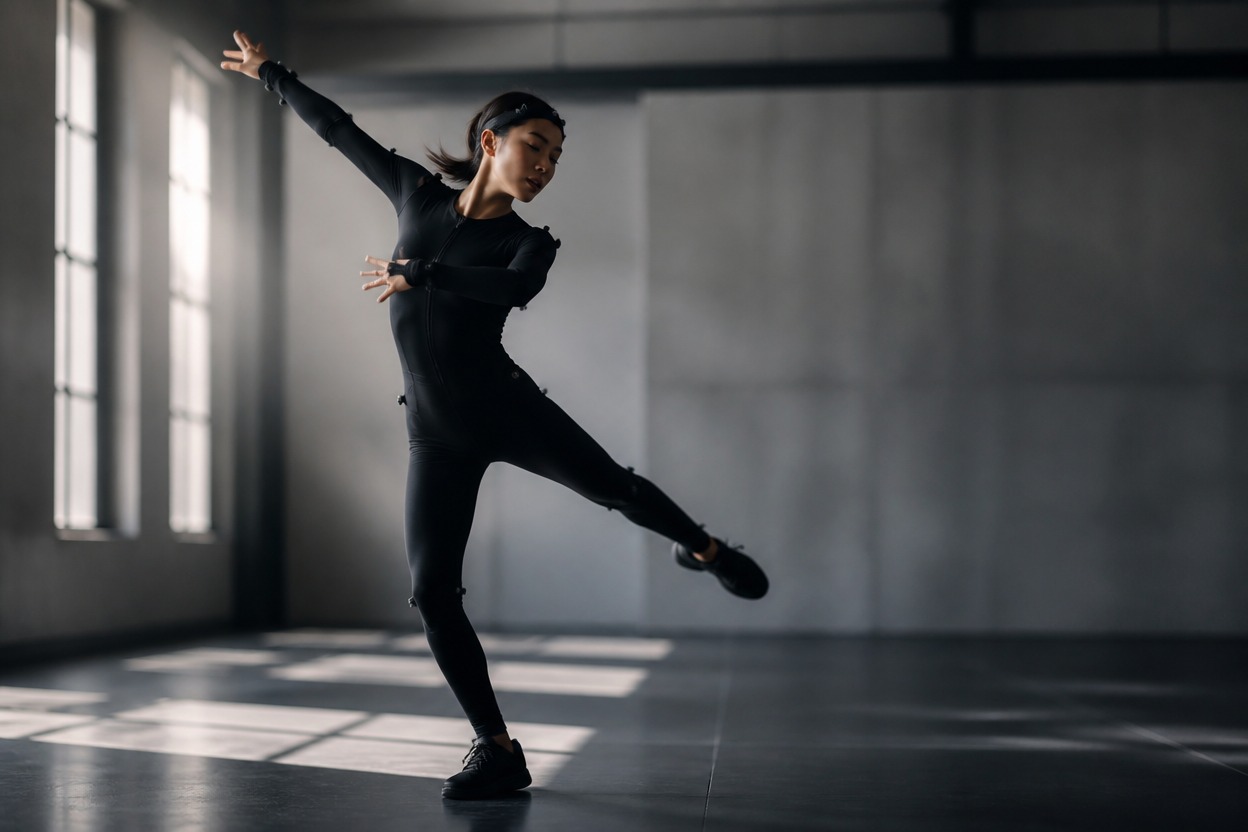
Single-scene choreography rehearsal used as a motion reference
Validate media before submission; unsupported duration or resolution values should be rejected client-side.

Kling V3 Motion Control API capabilities and validation rules

Endpoint and model

POST to <code>https://api.goenhance.ai/api/v1/videos/generations</code> with <code>model: kling-v3-motion</code>.

Prompt

Send a required <code>prompt</code> of up to 2,500 characters to describe the character, clothing, scene, or relevant generation direction.

Appearance input

An <code>image_url</code> may be JPG, JPEG, or PNG, up to 50 MB, at least 300 px per side, with an aspect ratio from 1:2.5 to 2.5:1.

Motion input

The required <code>video_url</code> must be MP4 or MOV, no larger than 100 MB, with dimensions from 340 to 3,850 px.

Orientation and length

<code>character_orientation: video</code> accepts 3–30 seconds; <code>image</code> accepts 3–10 seconds. The documented default is <code>video</code>.

Resolution and audio

Choose 720p or 1080p; there is no 4K tier. <code>generate_audio</code> keeps the motion video's original sound and defaults to false.
Pricing is per generated second, while GoEnhance measures the input motion-video length as the request's upper-bound charge.

Kling V3 Motion Control API pricing

720p rate

6.3 tokens per generated second, equivalent to $0.126/s at the documented $0.02 per token.

1080p rate

8.4 tokens per generated second, equivalent to $0.168/s at the documented $0.02 per token.

Cost estimate

Estimate the upper-bound request cost as the measured motion-video duration multiplied by the exact rate for the selected resolution.

Measured input billing

GoEnhance transfers and measures <code>video_url</code> before deducting tokens, so changing the remote file after measurement does not change the billed input.

Output may be shorter

Kling extracts usable continuous motion, so difficult or very fast motion can produce an output shorter than the reference video.

No duration parameter

Do not send <code>duration</code>; the endpoint rejects it, and output length follows the usable motion extracted from the reference video.

Integrate Kling V3 Motion Control in six steps

1. Create an API key
1

1. Create an API key

Create a GoEnhance API key and send it in the Authorization header.
2. Validate both references
2

2. Validate both references

Check image clarity and dimensions, then verify the motion video's format, size, dimensions, and orientation-dependent length.
3. Submit and persist the task
3

3. Submit and persist the task

POST the request with model: kling-v3-motion, then save the returned img_uuid before handing work to a background processor.
4. Track status
4

4. Track status

Poll GET /api/v1/jobs/detail or supply a publicly accessible HTTPS custom_callback_url.
5. Handle callbacks idempotently
5

5. Handle callbacks idempotently

Treat repeated status events safely. A callback that does not return HTTP 200 may be retried up to three times with a three-second timeout per attempt.
6. Store the terminal result
6

6. Store the terminal result

Separate processing, success, and failure handling, and save the final video URL only after the task reaches a terminal state.
Use media you are authorized to process and design for asynchronous completion.

Developer use cases for Kling V3 Motion Control

Character performance clips

Apply approved movement references to a consistent character appearance for short narrative or promotional video pipelines.

Dance and choreography previews

Transfer licensed rehearsal motion into character-led previews while preserving consent and source-audio rights.

Game character animation concepts

Generate motion studies from character art and recorded movement before committing to a full animation workflow.

Localized campaign variants

Parameterize prompts and appearance inputs for regional creative variants while reusing one job orchestration layer.

Virtual performer workflows

Build controlled performer pipelines around approved image references, motion assets, and orientation settings.

Previsualization

Test whether a motion reference is suitable for a character before downstream editing, compositing, and review.
Answers to common integration, pricing, validation, and Kuaishou API questions.

Kling V3 Motion Control API FAQ

Build with the Kling V3 Motion Control API